
The Evolution of Agricultural Tractors: From Traditional to Smart Farming
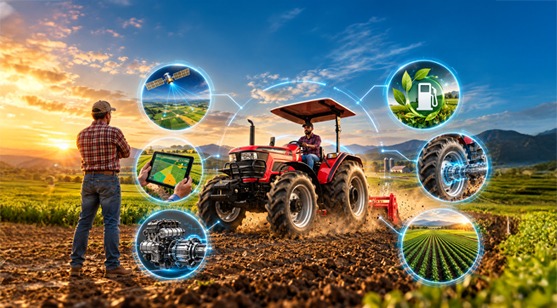
Few machines have shaped human civilisation as profoundly as the tractor. From the earliest steam-powered field engines of the nineteenth century to the GPS-guided, telematics-connected machines working fields today, the agricultural tractor has undergone a transformation that mirrors the broader story of human ingenuity applied to the most fundamental of all challenges: feeding the world.
Understanding how agricultural tractors evolved helps farmers appreciate not just where the technology stands today, but why the direction it is heading matters for every farming operation, large or small.
The Age of Animal Power and Early Mechanisation
For most of recorded history, farming was powered by animals and human labour. Oxen, horses, and bullocks pulled ploughs and harrows across fields that took days to prepare for a single crop cycle. The work was slow, weather-dependent, and physically demanding. The scale of what any single farming household could cultivate was directly limited by the strength and endurance of the animals available to them.
The arrival of the steam traction engine in the mid-1800s was the first significant break from this constraint. These large, heavy machines could pull implements across fields at a pace no animal team could match, transforming output on the farms that could afford and accommodate them. They were expensive, difficult to operate, and required significant infrastructure, but they proved beyond doubt that mechanical power had a future in agriculture.
The Petrol and Diesel Era
The development of the internal combustion engine brought agricultural tractors within reach of a far broader population of farmers. Henry Ford’s Fordson tractor, introduced in 1917, demonstrated that a compact, affordable, and mechanically reliable tractor could be manufactured at scale and used by ordinary farming households rather than only by large estates.
Through the early and mid-twentieth century, tractor design advanced rapidly. Diesel engines replaced petrol as the primary power source, offering better fuel economy and greater torque for field operations. The three-point linkage system, developed by Harry Ferguson in the 1920s and 1930s, transformed how implements connected to and were controlled by the tractor, creating the fundamental architecture that most agricultural tractors still use today.
By the latter half of the twentieth century, tractors had become genuinely powerful, reliable, and versatile machines capable of running a wide range of implements and working across diverse farming conditions around the world.
Hydraulics, Electronics, and the Modern Tractor
The introduction of sophisticated hydraulic systems gave farmers precise control over implement depth, pressure, and position without manual adjustment. Electronic controls followed, automating functions that had previously required constant operator attention and bringing a new level of consistency to field operations.
Cab design improved dramatically. Operators moved from open stations exposed to the elements into enclosed, comfortable working environments with improved visibility, ergonomic controls, and increasingly sophisticated instrument panels. These changes were not cosmetic. They reduced operator fatigue, improved accuracy, and allowed longer working days without the physical toll that earlier designs imposed.
The Digital Revolution and Smart Farming Solutions
The most significant transformation in agricultural tractors over the past two decades has been digital. GPS-guided steering, which allows tractors to follow pre-programmed field paths with centimetre-level accuracy, eliminated the waste inherent in manual steering and brought precision to field operations that had previously depended entirely on operator skill and attention.
Telematics systems now allow farm managers to monitor tractor performance, fuel consumption, operating hours, and maintenance requirements in real time from any location. Smart farming solutions built around connected equipment give farmers a quality of operational visibility that was simply impossible a generation ago.
Variable rate technology, precision seeding systems, and intelligent implement control allow modern tractors to adjust their behaviour dynamically based on field conditions, soil data, and agronomic targets. The tractor has evolved from a vehicle that carries power to the field into a platform that carries intelligence.
Where Agricultural Tractors Are Heading
The trajectory of tractor development points clearly toward further integration of automation, electrification, and data connectivity. Autonomous tractor prototypes capable of completing fieldwork without an operator on board are already being tested by leading manufacturers. Electric and hybrid powertrain options are moving from concept to commercial reality for compact and utility tractor segments.
Artificial intelligence applied to field mapping, soil analysis, and crop management is beginning to connect the tractor’s operation directly to the broader data ecosystem of the modern farm. The machine and the management system are becoming, progressively, a single integrated tool.
A Century of Progress. A Future Still Being Written.
The journey from ox-drawn plough to smart, connected agricultural tractor represents one of the most consequential technological progressions in human history. Each generation of farmers has inherited a more capable machine than the one before, and each generation has found new ways to push that capability further.
For today’s farmers evaluating their next tractor purchase, that history is not just background. It is the context for understanding why smart farming solutions built around modern agricultural tractors are not simply better equipment. They are a fundamentally different way of farming, with implications for productivity, sustainability, and profitability that will define the success of farming operations for decades to come.


